Fundamentals

Navagraha: The 9 Planets in Vedic Astrology and Their Powers
Published June 3, 2026 20 min read
Navagraha: The 9 Planets in Vedic Astrology and Their Powers

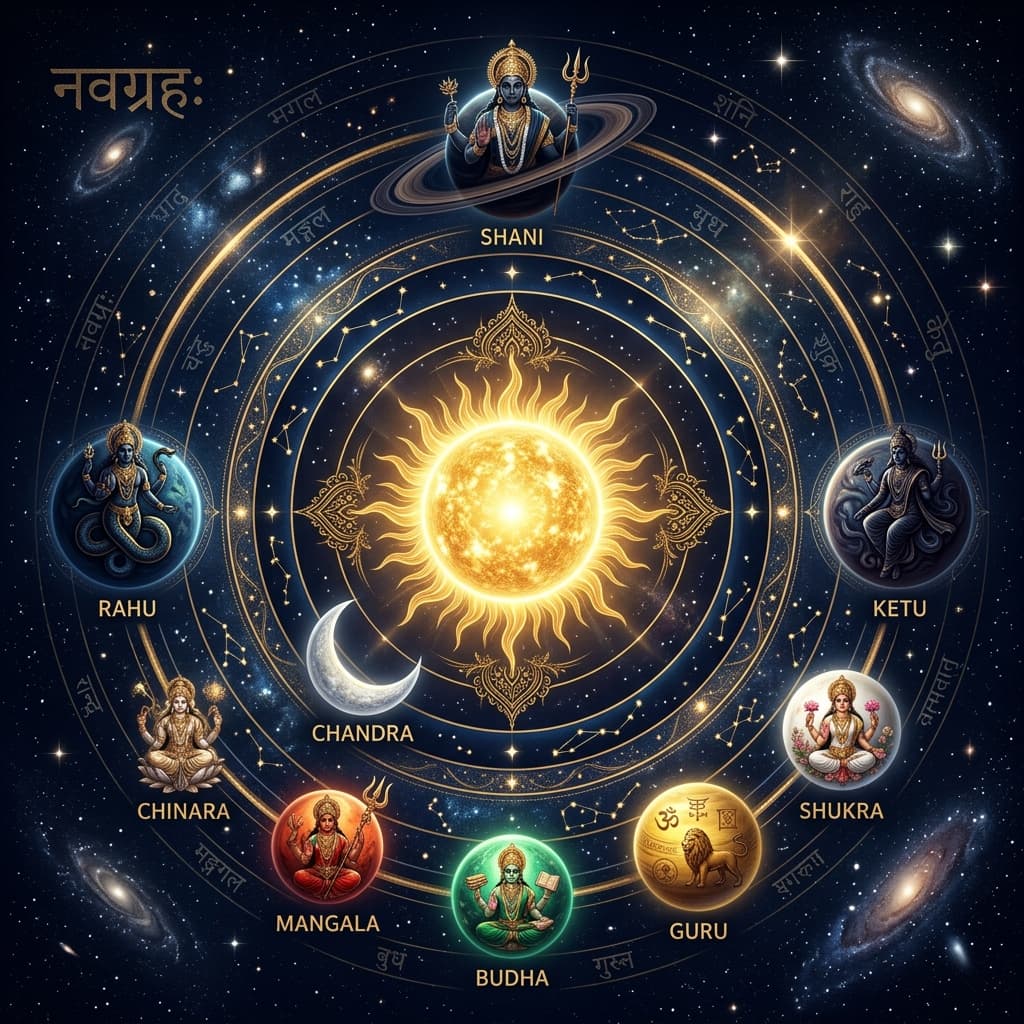
The foundation of Vedic astrology rests on nine cosmic forces called the Navagraha (nava = nine, graha = planet, or literally, that which seizes). Each Graha governs specific dimensions of human life: personality traits, body parts, professions, relationships, time periods, and spiritual lessons. Understanding each planet is the first step in reading your birth chart.

Surya — The Sun: Soul, Authority, and Father

**Surya (Sun)** is the king of the Navagraha. It represents the soul (Atma), ego, authority, government, father, and vitality. The Sun illuminates everything it touches. It is the planet of clarity, confidence, and leadership. The Sun takes approximately one month to transit each sign, completing the zodiac in one year.

  • **Rules**: Ego, soul, father, government, authority figures, heart, eyes (right eye for men)
  • **Own sign**: Leo (Simha), the natural 5th sign
  • **Exaltation**: Aries (peak at 10 degrees Aries)
  • **Debilitation**: Libra (weakest at 10 degrees Libra)
  • **Dasha period**: 6 years
  • **Gemstone**: Ruby (Manikya)
  • **Day**: Sunday

Chandra — The Moon: Mind, Mother, and Emotions

**Chandra (Moon)** is the fastest-moving Graha, transiting each sign in approximately 2.5 days. It governs the mind (Manas), emotions, mother, public, water, and subconscious patterns. In Vedic astrology, the Moon sign (Rashi) is often more important than the Sun sign, because it shows how you process experience emotionally and mentally.

  • **Rules**: Mind, emotions, mother, public, water, breast, left eye (for men), fertility
  • **Own sign**: Cancer (Karka)
  • **Exaltation**: Taurus (peak at 3 degrees Taurus)
  • **Debilitation**: Scorpio (weakest at 3 degrees Scorpio)
  • **Dasha period**: 10 years
  • **Gemstone**: Pearl (Moti)
  • **Day**: Monday

Mangal — Mars: Energy, Courage, and Ambition

**Mangal (Mars)** is the planet of action, courage, ambition, property, brothers, and physical energy. It is a natural malefic but a powerful activator. A well-placed Mars gives initiative, athletic ability, engineering talent, and the courage to fight for goals. A weak or afflicted Mars creates aggression, accidents, property disputes, and impulsive behavior.

  • **Rules**: Energy, courage, property, brothers, blood, muscles, accidents, surgeons
  • **Own signs**: Aries (Mesha) and Scorpio (Vrishchika)
  • **Exaltation**: Capricorn (peak at 28 degrees Capricorn)
  • **Debilitation**: Cancer (weakest at 28 degrees Cancer)
  • **Dasha period**: 7 years
  • **Gemstone**: Red Coral (Moonga)
  • **Day**: Tuesday

Budha — Mercury: Intellect, Communication, and Business

Budha (Mercury) governs intellect, speech, writing, business acumen, skin, and the nervous system. Mercury is the fastest-thinking planet. It drives analytical ability, humor, and commercial intelligence. Mercury is a natural benefic when associated with benefics and becomes malefic when associated with malefics; it absorbs the nature of its companions.

  • **Rules**: Intellect, communication, business, mathematics, writing, skin, nervous system, young people
  • **Own signs**: Gemini (Mithuna) and Virgo (Kanya)
  • **Exaltation**: Virgo (peak at 15 degrees Virgo)
  • **Debilitation**: Pisces (weakest at 15 degrees Pisces)
  • **Dasha period**: 17 years
  • **Gemstone**: Emerald (Panna)
  • **Day**: Wednesday

Guru — Jupiter: Wisdom, Wealth, and Grace

**Guru (Jupiter)** is the greatest natural benefic. It governs wisdom, knowledge, children, higher education, law, religion, and abundance. Jupiter expands everything it touches. A strong Jupiter in your chart is the most reliable indicator of blessings, the kind of luck that seems to arrive without obvious effort. Jupiter transits each sign for approximately one year.

  • **Rules**: Wisdom, children, wealth, teachers, religion, philosophy, law, fat in the body, liver
  • **Own signs**: Sagittarius (Dhanu) and Pisces (Meena)
  • **Exaltation**: Cancer (peak at 5 degrees Cancer)
  • **Debilitation**: Capricorn (weakest at 5 degrees Capricorn)
  • **Dasha period**: 16 years
  • **Gemstone**: Yellow Sapphire (Pukhraj)
  • **Day**: Thursday

Shukra — Venus: Beauty, Love, and Luxury

**Shukra (Venus)** is the planet of love, beauty, art, luxury, relationships, pleasure, and material comfort. It governs the romantic partner for males (the female partner is seen from Venus; for females, the male partner is seen from Jupiter). Venus is also associated with business, negotiation, and refined taste.

  • **Rules**: Love, beauty, creativity, luxury, spouse (for men), vehicles, jewelry, eyes, reproductive system
  • **Own signs**: Taurus (Vrishabha) and Libra (Tula)
  • **Exaltation**: Pisces (peak at 27 degrees Pisces)
  • **Debilitation**: Virgo (weakest at 27 degrees Virgo)
  • **Dasha period**: 20 years
  • **Gemstone**: Diamond (Heera) or White Sapphire
  • **Day**: Friday

Shani — Saturn: Discipline, Karma, and Time

**Shani (Saturn)** is the slowest-moving Graha among the seven classical planets, spending approximately 2.5 years in each sign and 30 years to complete the full zodiac. It is the planet of karma, discipline, restriction, longevity, service, and renunciation. Saturn is the ultimate teacher. It rewards discipline and delayed gratification while making life harder for those who rely on shortcuts.

  • **Rules**: Discipline, delays, longevity, servants, farmers, laborers, chronic disease, bones, teeth, legs
  • **Own signs**: Capricorn (Makara) and Aquarius (Kumbha)
  • **Exaltation**: Libra (peak at 20 degrees Libra)
  • **Debilitation**: Aries (weakest at 20 degrees Aries)
  • **Dasha period**: 19 years
  • **Gemstone**: Blue Sapphire (Neelam). Most powerful Saturn stone but requires proper testing before wearing.
  • **Day**: Saturday

Rahu — North Node: Obsession, Innovation, and Foreign Matters

**Rahu** is not a physical planet. It is a mathematical shadow point called the North Lunar Node, marking where the Moon's orbit crosses the ecliptic in an upward direction. Rahu behaves like an amplifier. It intensifies whatever it touches and creates insatiable desire, unconventional behavior, foreign connections, technology obsession, and worldly ambition. Rahu is the planet of the modern age.

  • **Rules**: Obsession, foreign lands, technology, innovation, deception, amplification, outcaste situations, epidemic
  • **Signs**: Rahu is exalted in Taurus per classical texts; it behaves like Saturn
  • **Dasha period**: 18 years
  • **Gemstone**: Hessonite Garnet (Gomed)
  • **Note**: Rahu always moves retrograde through the zodiac, opposite to natural planetary motion

Ketu — South Node: Detachment, Spirituality, and Past Life

**Ketu** is the South Lunar Node, the opposite point from Rahu. Where Rahu obsessively desires, Ketu detaches and releases. Ketu carries the accumulated karma and skills from past lives in areas where the soul has already mastered the lesson and seeks no further engagement. Ketu placements show where you have natural talent but feel an inexplicable disinterest. Spiritually, Ketu is the most powerful indicator of Moksha (liberation).

  • **Rules**: Detachment, spirituality, past life karma, isolation, moksha, occult, wounds, sudden events
  • **Signs**: Ketu is exalted in Scorpio per classical texts; it behaves like Mars
  • **Dasha period**: 7 years
  • **Gemstone**: Cat's Eye (Lahsuniya)
  • **Note**: Always directly opposite Rahu in the chart. If Rahu is in the 3rd house, Ketu is in the 9th.

Cosmic Remedy & Guidance

Natural Benefics (Naisargika Shubha Graha): Jupiter, Venus, waxing Moon (Shukla Paksha Moon), and Mercury when not associated with malefics. Natural Malefics (Naisargika Papa Graha): Sun, Mars, Saturn, Rahu, Ketu, and waning Moon (Krishna Paksha Moon). This is the inherent nature of each planet. Whether a planet acts as benefic or malefic for your specific chart depends on your Ascendant.

Frequently Asked Questions

What are the 9 planets (Navagraha) in Vedic astrology?

The nine Vedic planets are: Sun (Surya), Moon (Chandra), Mars (Mangal), Mercury (Budha), Jupiter (Guru / Brihaspati), Venus (Shukra), Saturn (Shani), Rahu (North Lunar Node), and Ketu (South Lunar Node). Rahu and Ketu are not physical planets but mathematical points, the intersections of the Moon's orbit with the ecliptic.

Why does Vedic astrology not use Uranus, Neptune, and Pluto?

Classical Jyotish was codified before the telescope era. The nine Navagraha were chosen because they are visible to the naked eye (except Rahu and Ketu, which are calculated mathematical points) and their cycles correlate with observable human experience. Some modern Vedic astrologers incorporate outer planets as supplementary factors, but they are not part of the classical system.

What is the most benefic planet in Vedic astrology?

Jupiter (Guru) is considered the greatest natural benefic in Vedic astrology. It represents wisdom, prosperity, children, and divine grace. Venus (Shukra) is the second natural benefic. The Moon when waxing and Mercury when associated with benefics are also considered benefic. The natural malefics are Sun, Mars, Saturn, Rahu, and Ketu, though they can produce excellent results in specific positions.

What is the difference between a natural benefic and a functional benefic?

Natural benefics (Jupiter, Venus, waxing Moon, Mercury) are inherently positive planets. Functional benefics depend on your Ascendant. They are the planets that rule the Kendra and Trikona houses for your specific Lagna. For example, Saturn is a natural malefic, but for a Libra Ascendant, Saturn rules the 4th and 5th houses (Kendra and Trikona), making it the most powerful functional benefic for that chart.

Further Cosmic Exploration