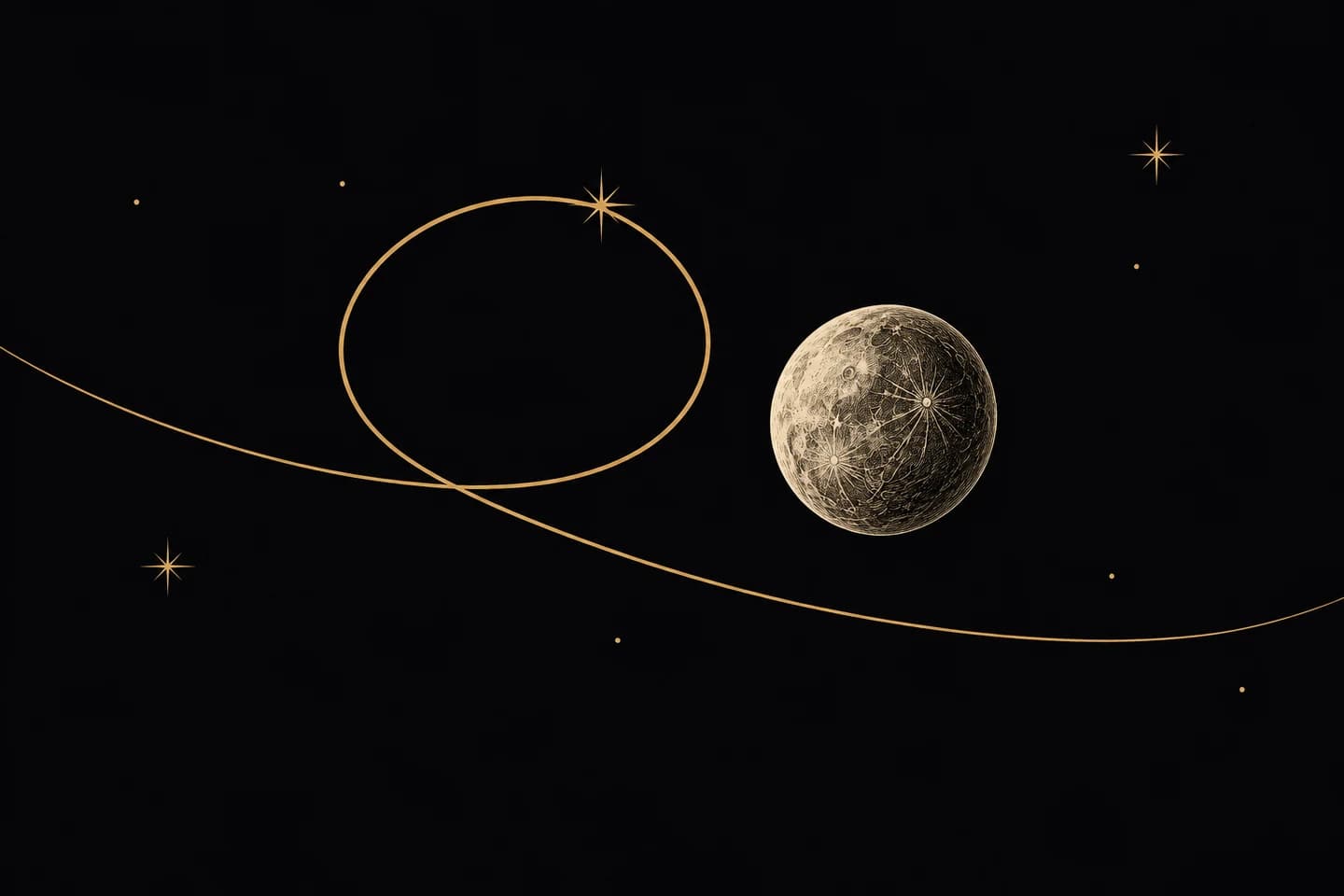
Mercury retrograde [vakri Budha] means Mercury appears to move backward in zodiac longitude as seen from Earth. The planet does not reverse its orbit around the Sun. The apparent change results from the changing geometry of Earth and Mercury as both move around the Sun.
Retrograde, station, and ingress are different
- Retrograde: apparent longitude decreases over time.
- Direct motion: apparent longitude increases.
- Station: the turning point between those directions, measured using a stated calculation method.
- Ingress: crossing a sign boundary, which can happen during direct or retrograde motion.
A planet can turn retrograde without changing signs that day. It can also cross back into a previous sign later in the retrograde interval. A useful calendar labels the event clearly and gives the zodiac system and time zone. “Mercury changes” is too vague to tell you which event occurred.
What Vedic interpretation adds
Mercury is traditionally associated with speech, calculation, learning, and trade. Retrograde readings often invite review or reconsideration of those themes. Other schools discuss motion-related strength [cheshta bala], which is an astrological score, not a measurement of harmful energy. Retrograde is not a universal synonym for weakness or disaster.
A natal retrograde placement [at birth] and a current transit are also different contexts. Neither establishes that someone is a poor communicator or that a particular email, journey, or contract must fail. A broad symbolic reading should not be turned into a diagnosis of a person’s abilities.
Why two calendars may print different dates
A station is an instant, but a calendar often displays a local day. An event late at night in one time zone may fall on the next day farther east. Small differences can also come from the ephemeris and how the turning point is estimated. Compare timestamps and settings before concluding that the underlying motion disagrees.
A “shadow period” is a term some astrologers use for the interval in which Mercury passes through degrees that will later be retraced, or has just retraced. It is not the same as being retrograde, and it is not a separate astronomical danger zone. If a calendar uses it, the definition should be visible.
A three-part communication check
- Content: are the names, figures, dates, and attachments correct?
- Understanding: does the other person interpret the request in the same way? Ask them to confirm the important point.
- Follow-through: who will do the next step, by when, and where is the agreement recorded?
These checks address real ways a message can fail. They are equally useful when Mercury is direct. If you keep notes, include uneventful days and successful tasks as well as errors; otherwise it is easy to notice only the incidents that fit a forecast and forget the ordinary days that do not.
A practical review without a blanket ban
Checking names, dates, attachments, backups, and agreed terms can be useful at any time. If a retrograde reminder helps you slow down and review, use it as a reminder. The value comes from the check itself; it does not establish that the planet caused an error or prevented one.
Do not assume an important opportunity should be refused or an essential action postponed solely because of a transit label. Examine the actual terms, risks, deadlines, and relevant advice. If you want a transit date, verify the year, time zone, and calculation settings rather than reusing last year’s list.
Questions you may have
Does Mercury physically move backward?
It continues around the Sun in its usual orbital direction. Retrograde is an apparent motion measured from Earth.
Should every contract wait until retrograde ends?
A transit label alone cannot decide that. Review the actual terms, deadlines, risks, and appropriate advice for the decision.