Vedic Astrology vs Western Astrology: The Complete Difference Explained
Ever found a completely different Sun sign in a Vedic app compared to a Western one? You aren't alone. This difference is due to a fundamental split between two ancient traditions—and it affects the accuracy of every prediction made about your life.
The Core Divide: Sidereal vs. Tropical Zodiac
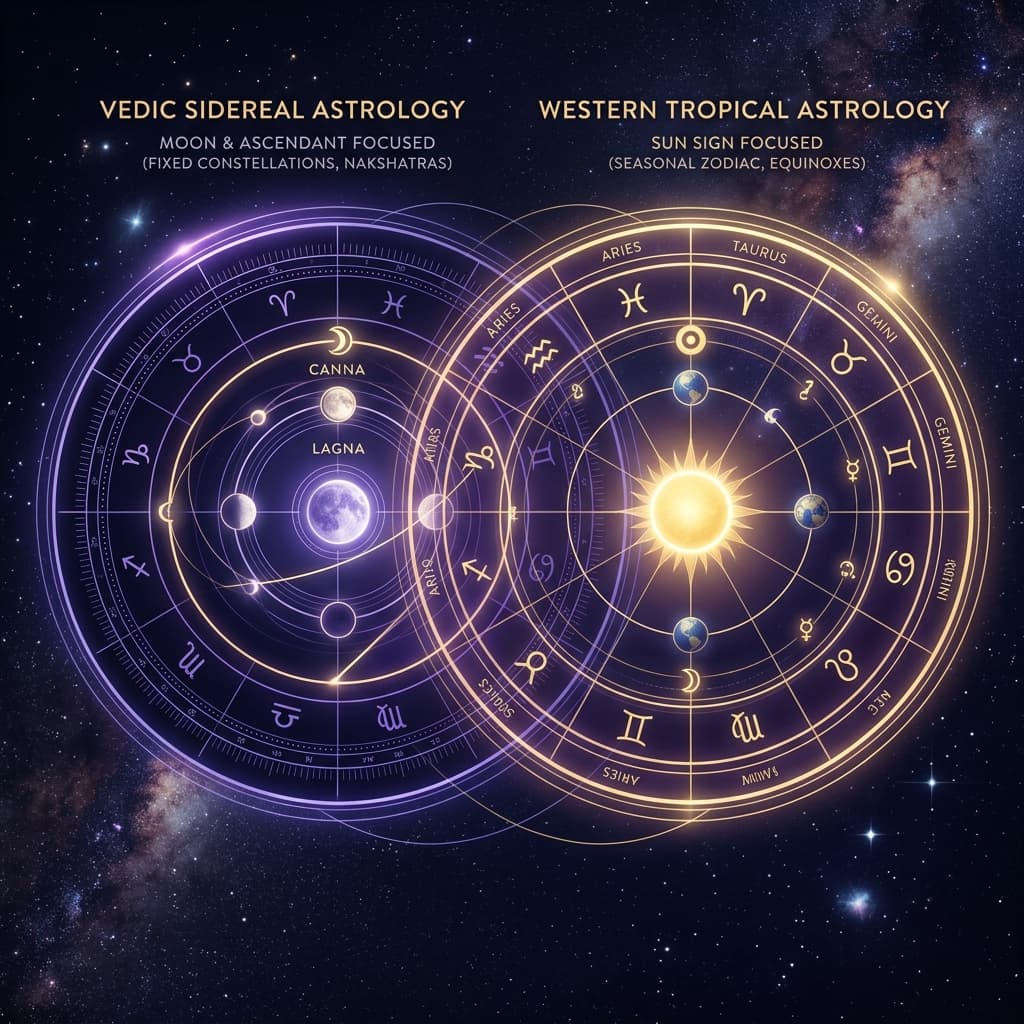
This single distinction underpins every other difference. Vedic astrology (Jyotish) uses the sidereal zodiac, which is fixed to the actual positions of the constellations in the sky. Western astrology uses the tropical zodiac, which is fixed to the seasons. In the Western system, 0 degrees Aries is always set to the Spring Equinox.
Two millennia ago, both systems aligned. But Earth's axis wobbles over a 26,000-year cycle called the Precession of the Equinoxes, causing the two zodiacs to drift apart by about 24 degrees—nearly one full sign.
Cosmic Remedy & Guidance
Practical impact: If Western astrology says your Sun is at 5 degrees Scorpio, Vedic places it at approximately 11 degrees Libra. Most people will find their Vedic Sun sign is one sign earlier.
What is Ayanamsha?
Ayanamsha is the technical term for the angular gap between the sidereal and tropical starting points. The Lahiri Ayanamsha (Chitrapaksha) is the official standard in India. In 2026, it stands at approximately 24 degrees and 7 minutes, meaning Vedic charts place planets about 24 degrees behind their Western positions.
Emphasis: Sun Sign vs. Ascendant and Moon
In Western astrology, the Sun sign is the centerpiece. In Vedic astrology, the Lagna (Ascendant) is the primary anchor of the chart because it changes every two hours. The Moon sign (Rashi) is also highly prioritized as it shows how you process experience emotionally and mentally.
- •Vedic priority: Lagna (Ascendant) > Moon Sign (Rashi) > Sun Sign
- •Western priority: Sun Sign > Rising Sign > Moon Sign
Planets Used: Classical Nine vs. Modern Ten
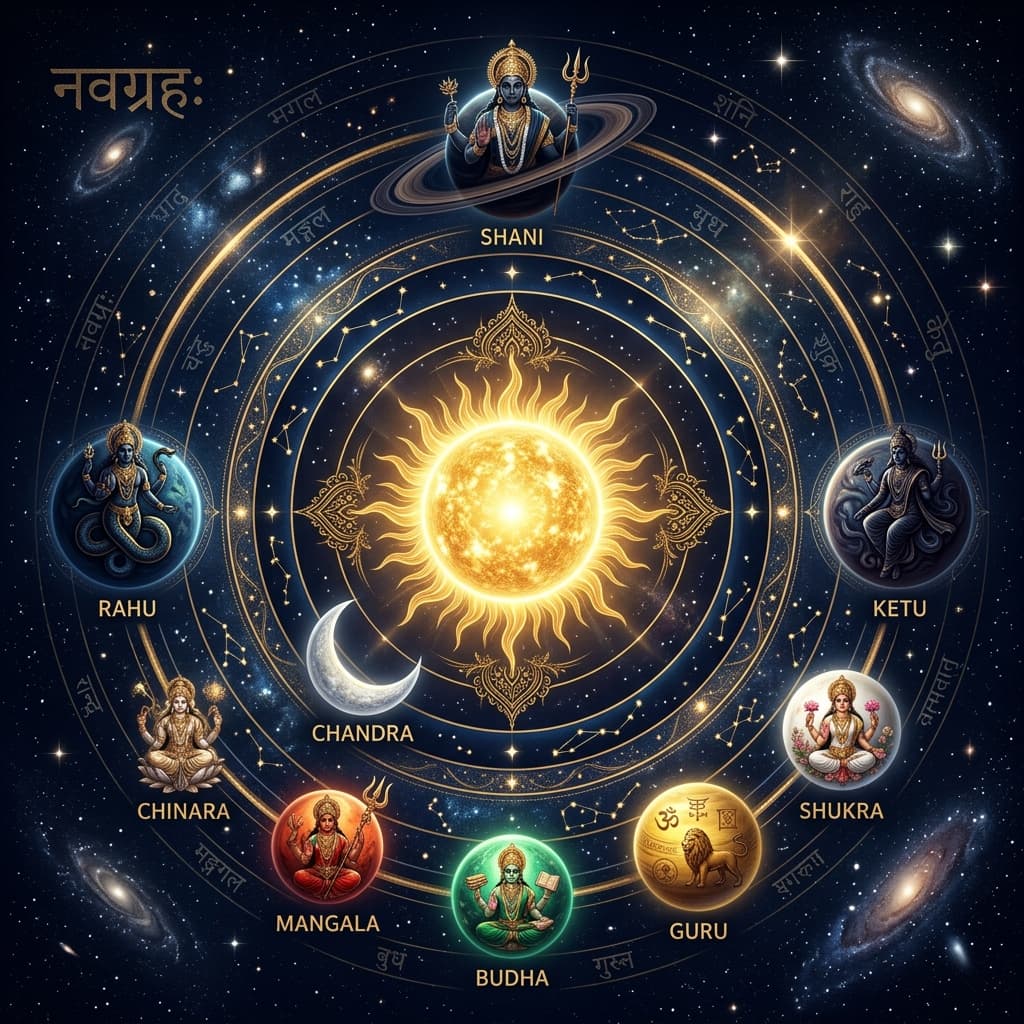
Traditional Jyotish works with the Navagraha: nine celestial bodies including Sun, Moon, Mars, Mercury, Jupiter, Venus, Saturn, Rahu (North Node), and Ketu (South Node). Uranus, Neptune, and Pluto are not part of the classical system.
Western astrology includes Uranus, Neptune, and Pluto. These outer planets are central to psychological and generational interpretation in Western practice. Classical Jyotish does not use them.
Predictive Tools: Dasha vs. Transits
This is the most significant practical difference. Vedic astrology has the Vimshottari Dasha system, a 120-year cycle of planetary periods. Knowing your current Mahadasha and Antardasha tells you exactly which planetary energy dominates your life right now.
Western astrology primarily uses transits and progressions. While Vedic astrology also uses transits, Dashas provide a structured, domain-specific timeline for major life events.
Cosmic Remedy & Guidance
Example: To forecast marriage, Vedic checks the 7th house lord's Dasha, Jupiter's transit, and the Navamsha. Western checks Venus transits, progressions, and synastry. Both work, but Dasha gives a precise timeline.
Divisional Charts (Vargas): A Vedic Exclusive
Vedic astrology uses 16 divisional charts (Vargas) derived from the main birth chart, each focusing on a specific area of life:
- •Navamsha (D-9): Marriage, dharma, and soul purpose (the most important divisional chart)
- •Dashamsha (D-10): Career, reputation, and public status
- •Saptamsha (D-7): Children and creativity
- •Drekkana (D-3): Siblings and initiative
- •Chaturthamsha (D-4): Property and home
Western astrology has no direct equivalent to Vargas, which provide domain-level precision for predictive analysis.
Psychological Depth vs. Predictive Precision
Western astrology excels in psychological profiling and counseling. It explores character archetypes, shadow work, and therapeutic growth.
Vedic astrology is an event-based, predictive science. Using Dashas and divisional charts, it answers specific timeline questions about career, marriage, health, and finance.
Which System Should You Use?
Choose Vedic astrology for precise event timing, marriage matchmaking, career cycles, and karmic analysis. Choose Western astrology for psychological self-awareness and archetypal exploration.
Many study both. But for concrete, mathematical forecasting, Vedic astrology's 5,000-year-old predictive framework is the standard.
Frequently Asked Questions
Why is my Vedic Sun sign different from my Western Sun sign?
Because Vedic astrology uses the sidereal zodiac (based on actual star positions), while Western astrology uses the tropical zodiac (fixed to the seasons). Due to precession, the two zodiacs have drifted about 24 degrees apart.
Is Vedic astrology more accurate than Western?
Vedic astrology is highly precise for timing life events using planetary periods (Dashas) and divisional charts. Western astrology excels in psychological profiling.
What is Ayanamsha in Vedic astrology?
Ayanamsha is the angular gap between the tropical and sidereal zodiacs. The Lahiri Ayanamsha is the official Indian government standard, currently around 24°07'.
Do Vedic and Western astrology use the same planets?
Vedic uses nine planets (Navagraha), excluding Uranus, Neptune, and Pluto. Western astrology includes all outer planets.