Mangal dosha [a traditional Mars-related chart condition] is also called Kuja dosha, and a person whose chart meets a chosen rule is often called Manglik. The label describes an astrological classification. It does not establish a curse, a violent personality, or danger to a future spouse.
What is actually being counted?
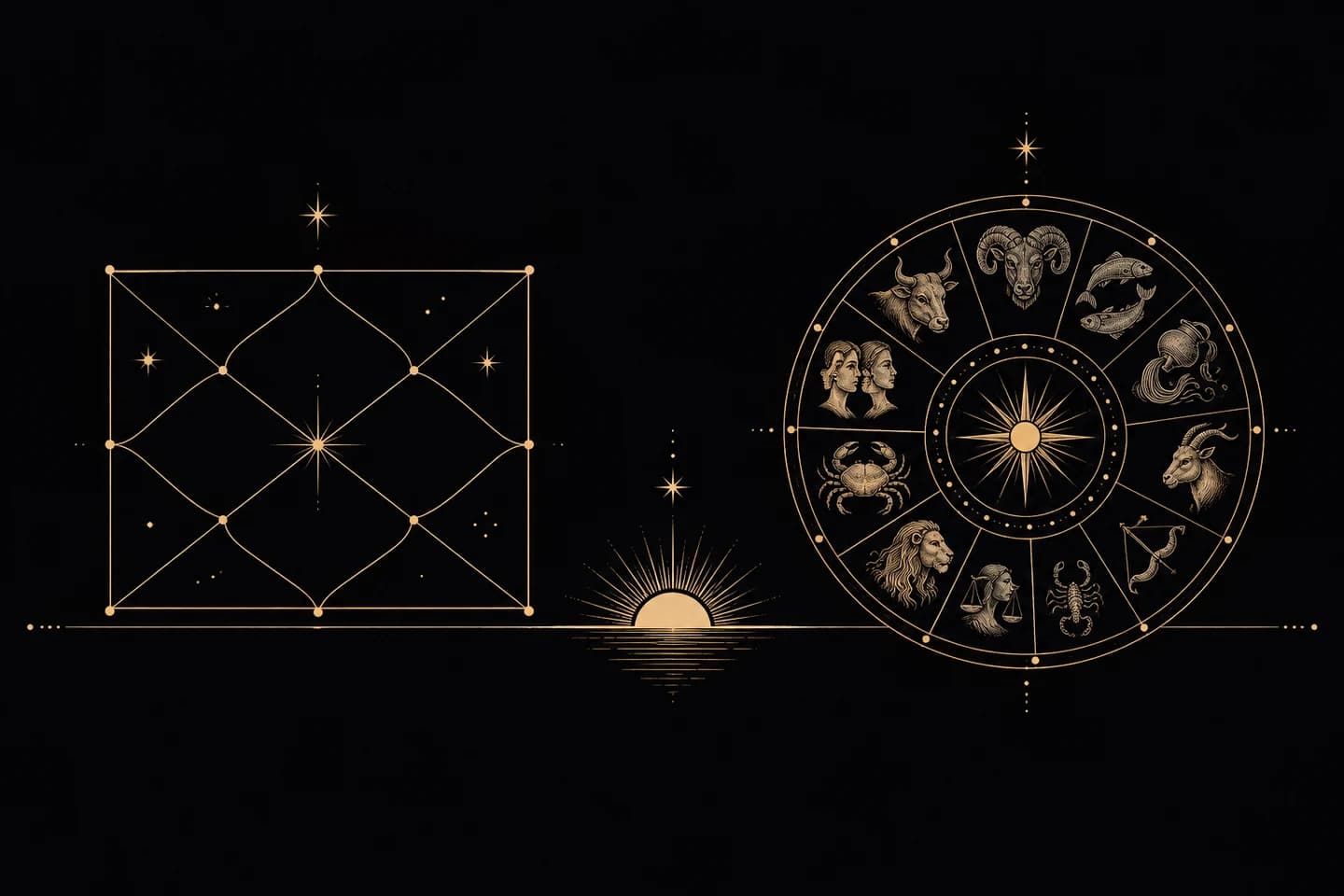
A widely used rule checks Mars in the first, second, fourth, seventh, eighth, or twelfth house [chart area]. Some traditions omit the second house or use a narrower list. Some count from the ascendant [rising sign], while others also assess the Moon or Venus. A report should say which reference and which list it uses.
Why one calculator says yes and another says no
Before interpreting the disagreement, compare the birth time, location, house system, zodiac setting, and reference point. Then compare exceptions. Rules called cancellation [dosha-bhanga or parihara] may consider the sign, other planets, or the other person’s chart. They differ between schools and should not be silently presented as one universal formula.
It is also important to distinguish “a rule was triggered” from “a harmful event will occur.” The first can be a checkable statement about chart coordinates. The second is a prediction that the coordinate check does not prove. Matching two Manglik labels does not by itself establish compatibility or remove every relationship difficulty.
Read Mars symbolism without labelling a person
In traditional interpretation, Mars is associated with effort, initiative, conflict, and assertion. A useful conversation might concern how two people express disagreement or divide responsibilities. Those questions should be answered through their actual behaviour, not by assuming anger or cruelty from a placement.
Follow one placement through two charts
Keep Mars in Libra in two fictional whole-sign charts. For Aries rising, it lies in the seventh house; for Leo rising, it lies in the third. The first placement meets the common house-list check described above and the second does not. Yet both people have the same Mars sign. This is why “Mars is in Libra” and “Mars triggers this dosha rule” are not interchangeable statements.
If a reader then switches to counting from the Moon, the reference changes again. A useful report keeps each result labelled: from the ascendant, from the Moon, or from Venus. It should not merge three checks into a frightening severity score without explaining what the number represents.
Common shortcuts that need a question
“It disappears at a particular birthday,” “two Manglik people automatically cancel it,” and “one ritual removes every risk” are broad claims. Ask for the exact rule and its limits. Age by itself does not change the natal longitude of Mars, and a ritual does not rewrite the birth chart. A tradition may change its interpretation; that should be described as interpretation.
The most useful outcome of this discussion is a clear explanation of the chart convention and a respectful conversation about relationships. Nobody needs to accept blame for a partner’s future misfortune to take family beliefs seriously. Practical compatibility still requires knowing the person and having the freedom to choose.
What to ask before accepting a frightening claim
- Which exact house and reference point triggered the label?
- Which interpretation or regional tradition is being followed?
- Is a cancellation being applied consistently, or only when convenient?
- Is someone claiming certainty about death, harm, or divorce that the calculation cannot establish?
- Can a proposed observance remain voluntary, affordable, and free of pressure on either partner?
Questions you may have
Does Mangal dosha predict a spouse’s death?
No chart label establishes that a person will cause a spouse’s death. Such a claim should not be used to stigmatise or coerce someone.
Can the label change if my birth time changes?
Yes, if the changed time moves the ascendant or relevant house boundary. A report should state the birth-time uncertainty and calculation method.