A retrograde is a change in how a planet appears to move through the zodiac from Earth. The planet keeps travelling around the Sun, while its apparent position can trace backward for a time. Once you understand that movement, station dates, shadow periods and the different calendar labels become much easier to follow.
The observer is moving too
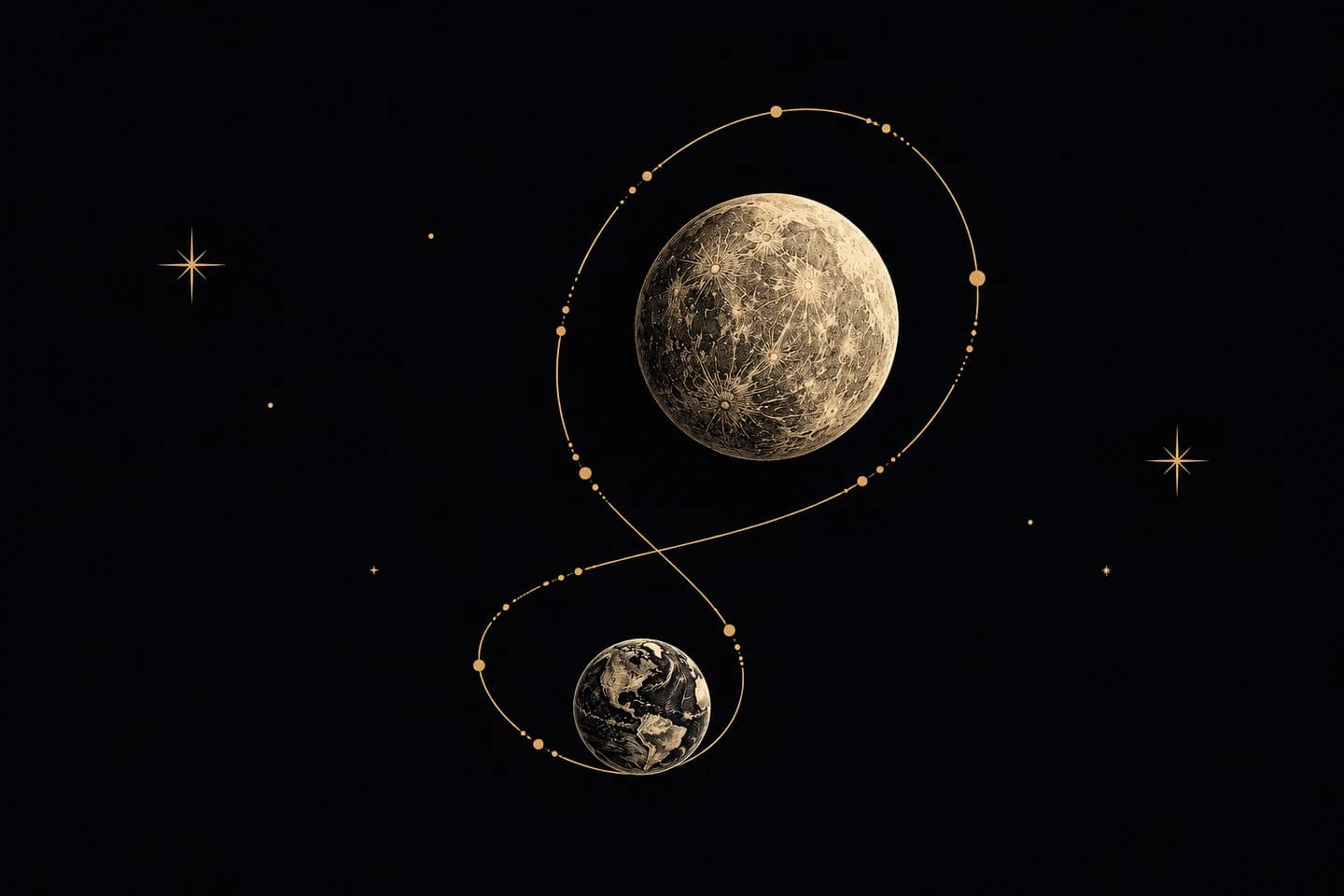
NASA explains apparent retrograde motion through the relative movement of Earth and the other planets. When Earth overtakes an outer planet such as Mars, that planet can appear to move backwards against the more distant background. Mercury and Venus orbit closer to the Sun than Earth does, so their changing viewing geometry also produces apparent reversals. No planet needs to stop travelling along its orbit for this to happen.
The everyday idea of passing another vehicle can help separate actual travel from apparent relative movement, but it is only an analogy. A planetary calculation uses coordinates and time, not a road model. For a calendar, ask which position measure is used. Apparent geocentric ecliptic longitude is a declared astronomical quantity; the sign name is a further way of labelling that position.
A station is a turning point in the measure
A retrograde station marks the change from direct to backward motion in the selected longitude measure. A direct station marks the reverse change. Around that turning point the longitude changes slowly, so rounded daily tables may make several dates look similar. An exact station time needs a declared model and frame. It is not simply the first day a rounded number repeats.
A sign ingress is different. It occurs when the longitude crosses a zodiac sign boundary. During a retrograde interval a planet can return to a sign it recently left. A calendar may therefore show more than one passage through a boundary. Do not merge those entries into one date or interpret each as a new orbital reversal.
Why the same event can have different labels
A tropical table and a Lahiri sidereal table can assign different sign names to the same station. That does not create two separate physical reversals. Timezone display can also place the shared instant on different local dates. If two published station times differ, compare the coordinate definitions and models before deciding that one is wrong. Agreement on a word such as retrograde is not a complete technical specification.
Read the traditional meaning separately
Astrological traditions attach meanings to retrograde motion, but the geometry does not show that all readers will experience the same difficulty. For Mercury-specific interpretation, use the existing Mercury retrograde guide. This article answers the prior question: what is moving backwards, relative to what, and how is the turning point identified?
Open the 2027 retrograde calendar and choose a cycle to follow. Mark its start and end, then check the zodiac setting before comparing it with your chart. If you want to explore the personal context, the timing sample shows how a reader brings the birth chart and planetary periods into the explanation.
Questions you may have
Does a retrograde planet reverse its orbit?
No. The retrograde label in a geocentric astrology calendar describes its apparent motion as viewed from Earth.
Are station and sign-entry dates the same thing?
No. A station marks a change in the direction of the chosen position measure. An ingress marks crossing a zodiac sign boundary.